- Role
- Independent concept, UX/UI and prototype
- Format
- Interactive demonstration and working interface builder
- Status
- Concept prototype, not an official Sonos product
Context
A home audio product has one shared set of capabilities: rooms, music, playback and volume. But people reach for those capabilities from different habits. One person thinks about a room first; another starts with music; a third searches before playing.
Problem
A single prescribed navigation can make a capable system feel unfamiliar. The design question was whether the route into a function could change while the underlying function and state stayed the same.
This is a design hypothesis, not a claim about Sonos users or measured product performance.
Role
I framed the question, designed the interaction model, built the mock interface and produced the interactive comparison. This is self-initiated work; Sonos did not commission or endorse it.
Approach
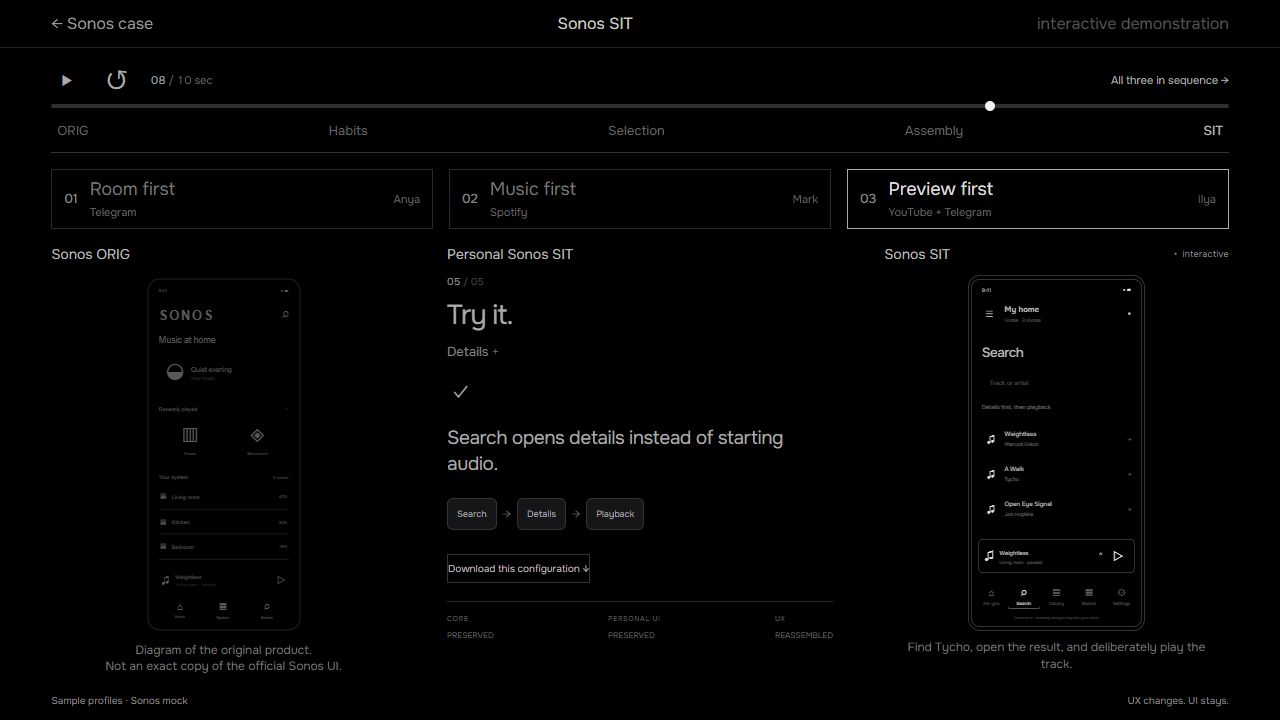
Keep one mock audio core. Let the entry point change according to a familiar mental model. Show the idea through three sample profiles instead of promising universal personalization.
Place
Start from the physical room, then reach playback and volume.
Content
Start from the track or playlist, then choose where it plays.
Exploration
Inspect a result before committing to playback.
Execution
The demonstration compares the mock original with the SIT paths, then walks through habit, selection and assembly. A separate local builder prototype supports configurable UI, reviewable semantic mapping and versioned layouts while the mock audio functions remain shared.
Best viewed on a desktop screen · no account required
Outcome
A working concept and demonstration make the design decision testable: different paths can reach the same mock functions. It does not establish that the approach improves usability in a real Sonos product; that would require research with users and production constraints.