- Role
- Independent product concept, design and implementation
- Format
- Playable browser experience and PC build
- Status
- Working independent project
Context
Carrier grew from an audio visualizer: spatial forms, spheres and node fields already responded to sound. I wanted to find out whether that language could support a game instead of remaining a passive image.
Problem
A visualizer can be beautiful without telling a player what to do. The design task was to make the audio response meaningful to movement, orientation and feedback while keeping the world legible enough to learn.
Role
I shaped the product concept, visual language and interaction, built the playable prototype with AI-assisted development, and designed its onboarding and controls. Carrier is an independent project, not a client commission.
Approach
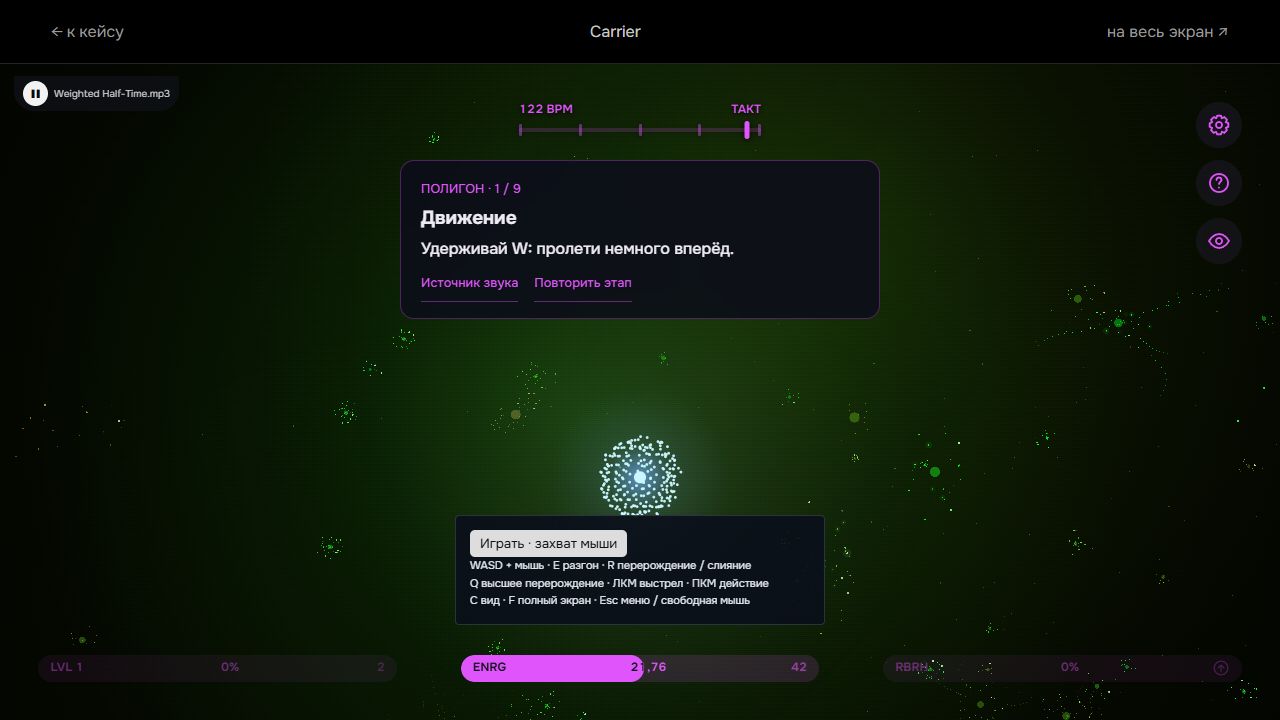
I kept the visualizer's node-based depth, then connected it to player action. The courier has a clear center; the world supplies spatial cues; the tutorial teaches movement in short steps before the player is asked to navigate freely.
Audio as material
Rhythm and spectrum affect the world's motion and visual response.
Playable movement
The player moves through the field instead of only observing it.
Guided learning
Short training steps introduce the controls and mechanics in context.
Execution
The working build includes a playable world, onboarding, keyboard and mouse controls, built-in music and progress indicators. The separate browser release lets a visitor experience the interaction directly.
Opens in a new tab · desktop controls recommended
Outcome
A playable product now demonstrates the transition from audio-reactive visual system to an interactive world. The build proves the concept can be played and taught; I am not claiming commercial traction or validated retention metrics.